How to Weigh Grams Without a Scale
You can weigh grams without a scale by comparing your item against household objects with known weights — a US nickel is exactly 5 g, a sheet of letter paper about 4.5 g — or by photographing the item with an AI estimator app like Scale AI, which returns a gram estimate with a confidence level in seconds.
Whether you're portioning ingredients mid-recipe, guessing whether a letter needs extra postage, or sorting hobby supplies like resin, yarn, or model parts, the same problem keeps coming up: you need a weight in grams and the kitchen scale is missing, dead, or was never bought in the first place. Here are the methods that actually work, from old-school reference tricks to a one-photo answer.
Use household objects with known weights
Coins and paper are manufactured to tight tolerances, which makes them surprisingly good reference weights:
- US nickel: 5.0 g — the classic calibration coin.
- US penny (1983 or later): 2.5 g.
- US quarter: 5.67 g.
- 1 euro coin: 7.5 g; 1 UK pound coin: 8.75 g.
- Sheet of 20 lb letter paper: about 4.5 g.
- AA battery: roughly 23 g (alkaline).
- 1 US tablespoon of water: about 14.8 g; 1 teaspoon about 4.9 g.
To use them, build a simple balance: rest a ruler across a pencil or the edge of a can, put your item on one end and stack coins on the other until the ruler levels out. Count the coins and you have a workable gram figure. For cooking, measuring spoons plus a density chart get you close — water-like liquids weigh about 1 g per milliliter, flour about 0.5–0.6 g per milliliter.
Match against packaged goods
Almost everything in your pantry has its net weight printed on the label. Holding a mystery item in one hand and a 100 g chocolate bar or a 500 g bag of pasta in the other is a crude but genuinely useful human balance for postage-style questions like "is this under 100 grams?" Your hands can usually feel a difference of 20–30% between two objects of similar size.
The fastest way: Scale AI on iPhone
If you'd rather skip the coin-stacking, Scale AI turns your iPhone camera into a photo-based gram scale. It won't replace a certified scale, but for everyday "roughly how many grams is this?" questions it's the quickest route to an answer:
- Open Scale AI and make sure Weigh Item mode is selected (it's the default).
- Place your item on a plain surface and, ideally, put a common reference object next to it — a coin, a credit card, or your hand helps the AI judge size.
- Tap Capture, or import an existing photo from your gallery.
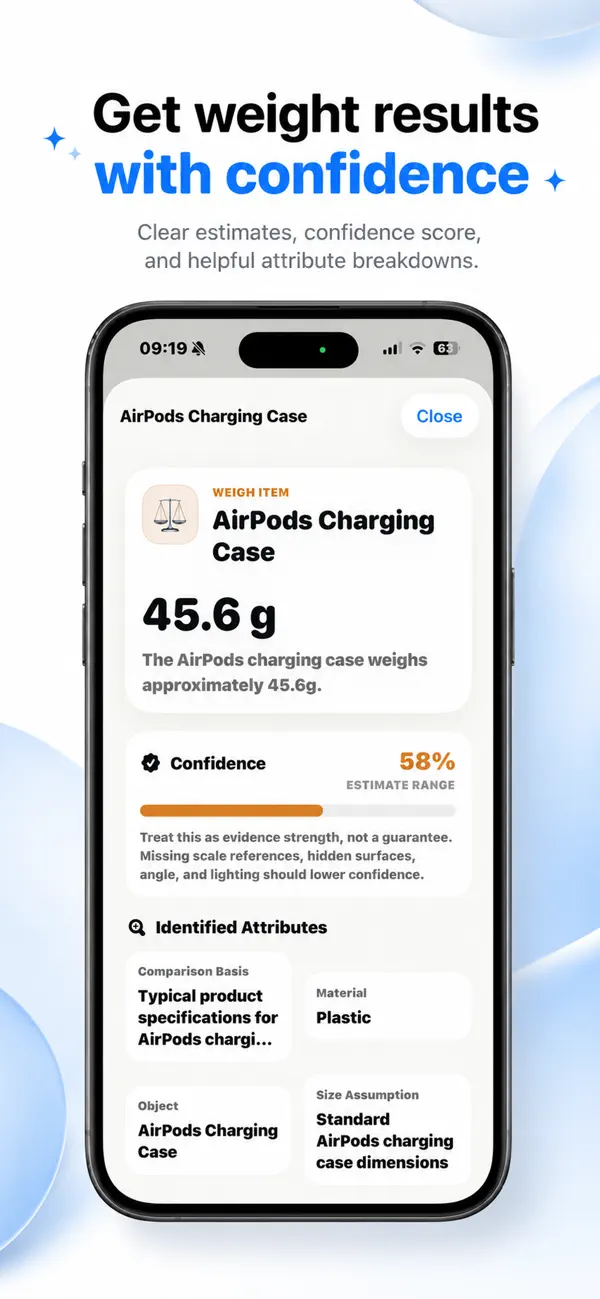
- Read the result: a weight estimate in grams or ounces, a confidence level, and the assumptions the AI made (material, typical product specs, size).
- Check the confidence bar. A high score means the AI recognized the object and its typical weight; a low score means treat the number loosely.
Every scan is saved to a local history, so you can compare estimates across items — handy when you're triaging a pile of parcels or portioning several ingredients in a row. Units switch between grams and ounces in settings.
Know the limits
Every method on this page — coins, balances, hand-weighing, and AI — produces an estimate, not a measurement. Scale AI in particular is built for quick everyday estimates and says so on every result: its numbers can be wrong and should never be used for medical dosing, legal, financial, or other decisions where accuracy matters. For those, use a certified scale.

Reference weights worth memorising
These are minted and manufactured to a specification, which is why they work as reference weights at all. Coins are the most reliable household standard you have — a worn coin loses a tiny fraction of a percent, not grams.
| Object | Weight | Useful for |
|---|---|---|
| US nickel | 5.000 g exactly | The best single reference in a US pocket |
| US quarter | 5.670 g | Stacking to 20–50 g |
| US penny (1983 onward) | 2.500 g | Fine increments |
| Euro 2€ coin | 8.50 g | Larger steps |
| Euro 1 cent | 2.30 g | Fine increments |
| UK £1 (12-sided) | 8.75 g | Larger steps |
| A4 sheet, 80 gsm | 5.0 g | Paper is sold by weight per m², so this is exact |
| AA alkaline battery | ~23 g | Rough 20–25 g checks |
| US dollar bill | ~1.0 g | Very small increments |
The A4 figure is worth understanding rather than memorising: gsm means grams per square metre, and an A4 sheet is exactly one sixteenth of a square metre. So 80 gsm paper gives 80 ÷ 16 = 5 g per sheet, and a 500-sheet ream is 2.5 kg. That makes printer paper the one household item whose weight you can calculate rather than look up.
Frequently asked questions
How accurate is weighing without a scale?
A balance built from a ruler and coins gets you within roughly a gram or two on small items, which is fine for postage or cooking and not fine for anything where precision matters. A camera estimate gives a ballpark with a confidence level attached, not a measurement.
Can I use my phone screen as a scale?
No. Some apps claimed this using 3D Touch on older iPhones, but that hardware was removed and the technique never worked reliably anyway. Any app promising a true scale from the screen alone is not being straight with you.
What is the most accurate no-scale method?
A DIY balance with coins as counterweights. It is a genuine comparison against a known mass, which is what weighing actually is, and coins are manufactured to tight tolerances.
Can Scale AI weigh anything?
It estimates. It works best on everyday objects photographed with something in frame for scale, and it tells you how confident it is. For medication, precious metals, or anything legal or safety-critical, use a calibrated scale.